
Business case
The business case
for NeuroGlass
The numbers a champion can forward to finance: less spent getting to analysis-ready data, less manual effort, and no data-egress bill — because nothing ever leaves your storage.
the collaboration layer
The expensive part isn't storage — it's the work you redo
NeuroGlass is more than a viewer: it turns exploration into shared, reproducible work. Without that layer, results live on laptops and in people's heads — and every share, re-find and re-trace is time you pay for twice.
Without a collaboration layer
Work that evaporates
A view lives on one laptop, in one person's head — and leaves when they do.
Sharing a result means a screenshot, a shipped drive, or "can you re-find that view?"
The same neuron gets traced twice, because no one can see who did what.
Every figure is rebuilt from scratch — with no way to reopen the exact state.
Terabytes get copied between people and sites: egress, drift and delay.
With NeuroGlass
Work that compounds
Every view is a reproducible Glance anyone can reopen — months, or people, later.
Work happens in shared, versioned Studies, with comments and tasks in context.
Teams across labs, sites and countries work on the same data, in the same view.
Figures link back to the exact source state, ready to regenerate.
Data streams from your own storage — nothing is copied, nothing leaves.
Outcomes
Turn raw volumes into analysis-ready data — faster, and for less.

~49%
lower cost to analysis-ready data

70%
less manual correction effort

Zero
data movement — runs on your own storage

Minutes
to share a reproducible 3D view
Figures teams report versus their prior setup. Your savings depend on data volumes, workflow and deployment — talk to us to model your own.
where the cost goes today
Three line items NeuroGlass removes
Most volumetric-imaging budgets bleed in the same three places. NeuroGlass takes each one off the table.
Data egress & duplication
Moving and copying terabyte-scale volumes racks up egress fees and duplicate storage. NeuroGlass streams from your own buckets — no copies, no transfers, no egress bill.
Manual handoffs & correction
Hard-drive shipping, re-formatting and manual QC eat scientist and engineer time. Shared, versioned Studies and in-context review cut that effort by up to 70%.
Tool sprawl & bespoke infra
Home-grown viewers, converters and glue code carry a standing maintenance cost. One platform on open Neuroglancer replaces the stack you keep patching.
what to take to finance
The argument for Finance
Everything a champion needs to justify the spend internally — without a committee.
Consolidated spend
One platform replaces viewers, converters, transfer tooling and bespoke infra — a single line item instead of a sprawling, hard-to-forecast stack.
No egress, no data risk
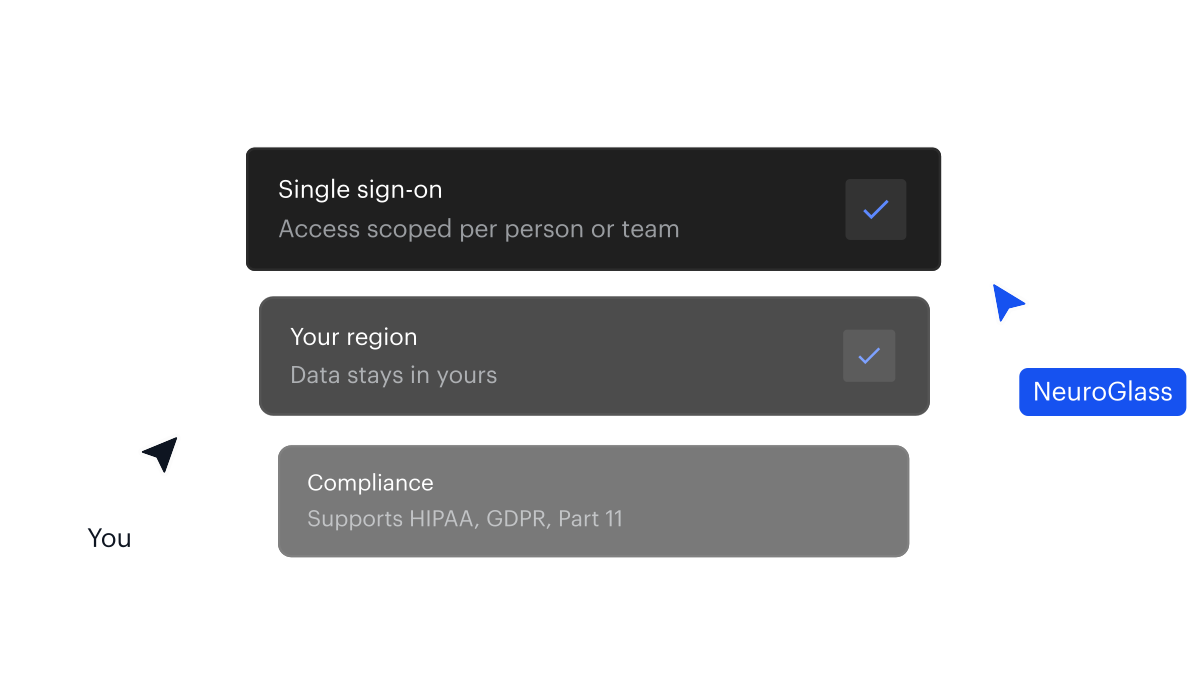
Data never leaves your storage, region or control — removing both the egress cost and the security exposure that stall procurement.
More results per scientist
Reproducible, in-context review turns days of packaging and re-finding into minutes — so each scientist ships more results per quarter.
Knowledge that compounds
Studies, Glances and Figures preserve the context around every result — so work survives turnover and accrues as an institutional asset instead of walking out the door.
Model your own numbers
Walk through your current pipeline with one of our engineers and we'll put real figures — your data volumes, your storage, your team — against your existing setup.
Frequently Asked Questions
Can't find an answer? Contact us
Isn't this just a viewer — where's the value beyond cost savings?
Where do the ~49% and 70% figures come from?
How does "zero data movement" save money?
Do we have to commit budget to evaluate it?
What about the cost of switching?
Allen Institute using NeuroGlass to support large-scale brain imaging workflows
Read the Press Release


